
NGS and Oncology Laboratory Developed Tests (LDTs)
Short answer: Many clinical NGS cancer panels are laboratory developed tests. Before reporting, the lab must establish performance under 42 CFR 493.1253(b)(2) for each variant type and specimen type, including accuracy, precision, limit of detection by allele fraction and bioinformatics performance, following the AMP/CAP NGS validation guideline and, for New York specimens, Wadsworth's NGS oncology guidelines.
Last reviewed: November 19, 2026. Primary sources: AMP/CAP NGS oncology validation guideline, NYS Wadsworth NGS oncology guidelines, 42 CFR 493.1253 and NCD 90.2.
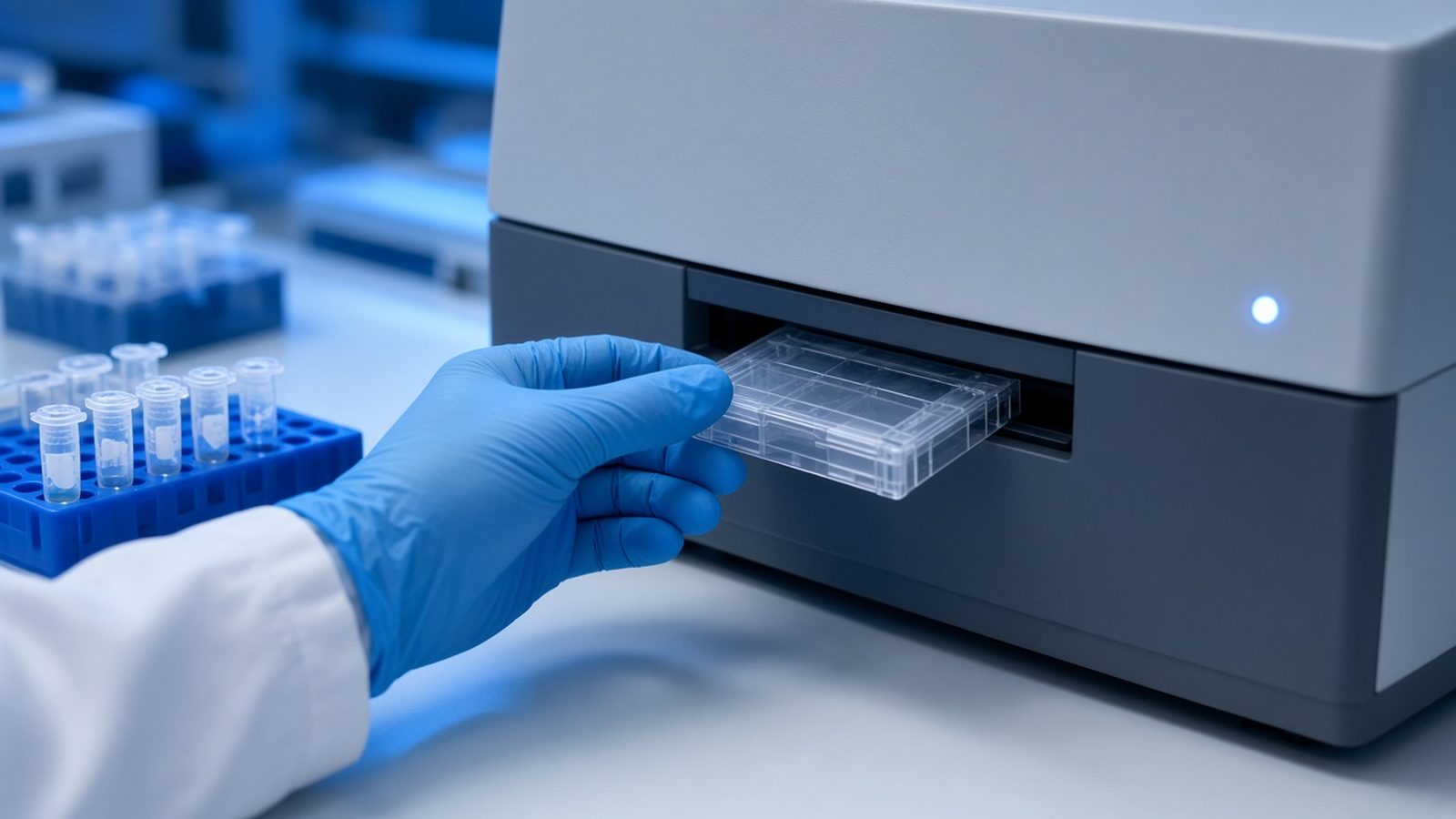
Why NGS oncology tests are usually LDTs
CRS cites genomic cancer testing as a core LDT area (CRS), and the 2026 CMS/CDC CLIA RFI named NGS for somatic or germline variants, minimal residual disease and methylation as applications with unique performance characteristics (91 FR 43586). Some FDA-approved NGS tests exist, but many panels are designed and validated by the lab that runs them.
Validation framework
| Area | What to establish | Source |
|---|---|---|
| Design and optimization | Targets, regions, specimen types, variant types; optimize before validating | AMP/CAP |
| Error-based approach | Identify likely failure points across wet lab and pipeline and design studies to detect them | AMP/CAP |
| Accuracy by variant type | SNVs, small indels, CNVs, fusions/structural variants; report positive percent agreement and positive predictive value | AMP/CAP |
| Analytical sensitivity | LoD by variant allele fraction and tumor content; coverage depth | AMP/CAP; 493.1253(b)(2)(iii) |
| Precision | Repeatability and reproducibility across runs, operators, instruments and lots | AMP/CAP |
| Specimen types | FFPE, blood, bone marrow, cfDNA: validate each claimed type | Wadsworth NGS guidelines |
| Complex biomarkers | MSI and TMB if reported | Wadsworth |
| Bioinformatics | Version-locked pipeline, reference genome and databases; revalidate after changes | Pipeline validation |
| Ongoing QC | Run metrics, positive and negative controls, contamination checks | NGS run QC metrics |
ADLM's 2026 comments to CMS add characteristics such as uniformity of coverage, variant-calling reproducibility, index hopping, cross-sample contamination and reference database version control (ADLM). Detailed study design: NGS assay validation under CLIA.
Reference materials and samples
The AMP/CAP guideline recommends using reference materials, cell lines and mixing studies to reach variants and allele fractions that are hard to find in clinical samples (AMP/CAP). Document the source, characterization and variant content of every material.
New York State
For New York specimens, Wadsworth publishes NGS oncology guidelines that set expectations for validation submissions (Wadsworth NGS guidelines, Oct. 2024). See NYS CLEP LDT approval.
Building, validating or fixing an LDT? We help CLIA labs plan and document LDT development and validation and prepare for CLIA, CAP and New York State review.
Medicare coverage for NGS LDTs
- NCD 90.2 covers NGS for patients with advanced cancer under defined conditions; FDA-approved companion diagnostics are covered nationally, and other NGS tests may be covered at Medicare contractor discretion (NCD 90.2).
- MolDX LCDs such as L38067 (solid tumors) and L38070 (myeloid malignancy LDTs) set coverage criteria and require a technical assessment.
- See LDT reimbursement and MolDX technical assessment.
Lab setup links
- What is next-generation sequencing (NGS)?
- NGS lab setup consulting
- NGS lab design and layout
- NGS library preparation
- NGS PT and CAP checklist
- CAP NGS worksheets
- Clinical NGS workflow compliance
How Sound Lab Consultants helps
- Design NGS validation plans by variant type, specimen type and allele fraction.
- Review reference material strategy and statistics (PPA, PPV, LoD).
- Prepare CAP NGS worksheets, NYS submissions and MolDX dossiers.
Talk through your test with an LDT regulatory consultant. Bring your intended use, platform and target launch date.
Frequently asked questions
Are NGS cancer panels laboratory developed tests?
Many are. They are designed and validated by the laboratory that runs them. Some FDA-approved NGS tests exist; a lab that runs one unmodified verifies it instead.
How do you validate an NGS LDT?
Follow 42 CFR 493.1253(b)(2) and the AMP/CAP NGS guideline: optimize first, then validate accuracy by variant type, precision, limit of detection by allele fraction, each specimen type and the locked bioinformatics pipeline.
What accuracy metrics are used for NGS validation?
The AMP/CAP guideline recommends reporting positive percent agreement and positive predictive value for each variant type, such as SNVs, indels, CNVs and structural variants.
Does Medicare cover NGS LDTs?
Under NCD 90.2, NGS tests for advanced cancer that are not FDA-approved companion diagnostics may be covered at contractor discretion. In MolDX states, coverage requires meeting LCD criteria and a technical assessment.
Does New York have special NGS requirements?
Yes. Wadsworth publishes NGS oncology guidelines that New York reviewers use for test approval submissions.
Sources
- AMP/CAP guidelines for validation of NGS-based oncology panels (2017)
- NYS Wadsworth NGS oncology guidelines (Oct. 2024, PDF)
- 42 CFR 493.1253
- 91 FR 43586 CLIA RFI
- CRS In Focus IF11389
- ADLM response to CMS CLIA RFI (PDF)
- CMS NCD 90.2 Next Generation Sequencing
- LCD L38067 MolDX NGS for solid tumors
- LCD L38070 MolDX NGS LDTs for myeloid malignancies
Sound Lab Consultants is an independent consulting firm. It is not affiliated with, endorsed by or acting for CMS, CDC, FDA, the College of American Pathologists, the New York State Department of Health or any accrediting organization or Medicare contractor. This page is general regulatory information, not legal advice. Confirm current requirements with the agency or accreditor that oversees your laboratory. Sound Lab Consultants, 25 Arizona Pl, Chandler, AZ 85225.