
North Dakota Lab Consultant: CLIA, Lab Startup and Compliance Support
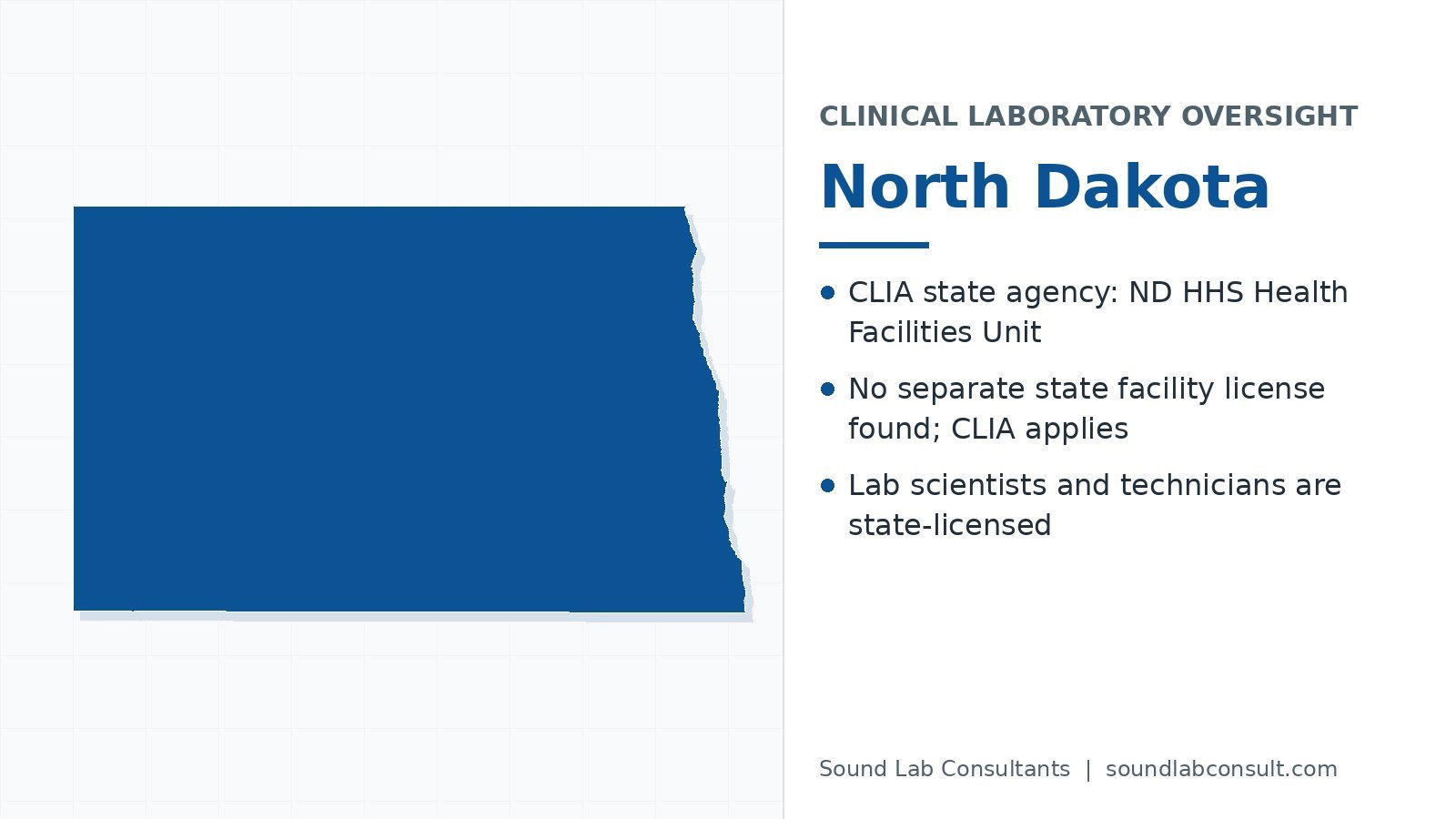
Short answer: North Dakota clinical labs are certified under federal CLIA through North Dakota Health and Human Services (ND HHS), Health Facilities Unit, which ND HHS says covers nearly 900 entities in the state that do some type of lab test. We found no separate North Dakota clinical laboratory facility license on ND HHS's site. North Dakota does license people: clinical laboratory scientists and technicians need a license from the North Dakota Board of Clinical Laboratory Practice unless exempt (N.D. Cent. Code 43-48-02).
Last reviewed: November 20, 2026. Sources: CMS CLIA State Agency Contacts (revised September 2026), North Dakota HHS: CLIA Laboratories, N.D. Cent. Code chapter 43-48 (clinical laboratory practice).
What a North Dakota lab consultant does
A North Dakota lab consultant helps clinical labs get and keep CLIA certification through North Dakota Health and Human Services, staff the lab with people who meet both CLIA and North Dakota licensing rules, and pass state agency surveys or accreditation inspections. Much of the state's testing happens in small clinic and critical access hospital labs, so remote technical consultant and supervisor support, competency programs and survey preparation are common needs.
North Dakota has no separate state facility license that we could find on ND HHS's site, but clinical laboratory scientists and technicians must hold North Dakota licenses.
North Dakota regulator at a glance
- CLIA state agency: ND HHS Health Facilities Unit, 1720 Burlington Dr, Suite A, Bismarck, ND 58504-7736, (701) 328-2352, CLIAlab@nd.gov (CMS list).
- Form CMS-116 and CMS-209 personnel report go to ND HHS.
- Personnel licenses: North Dakota Board of Clinical Laboratory Practice (N.D. Cent. Code 43-48).
- Certificate lookup: CMS QCOR CLIA Laboratory Lookup.
- Full details: North Dakota clinical lab licensing and CLIA.
How to hire a lab consultant in North Dakota
- Write down your goal: new lab, certificate upgrade, new specialty, director change or survey response.
- Confirm the state path: Health Facilities Unit, CLIA program (listed by CMS as North Dakota Dept of Health Division of Health Facilities) (CLIAlab@nd.gov).
- Ask each consultant for North Dakota experience, a written scope and deliverables (procedures, validation reports, quality plan, competency records).
- Check independence: no consultant can promise approval or speak for CMS, the state or an accreditor.
- Send your test menu, instruments, current certificate and staff credentials so the quote is specific.
Full checklist: Hire a North Dakota lab consultant.
CLIA lab director and personnel roles
| Role | When CLIA requires it | Rule |
|---|---|---|
| Laboratory director | Every non-waived lab (moderate or high complexity) | 42 CFR 493.1405 (moderate), 493.1443 (high) |
| Technical consultant | Moderate complexity testing | 42 CFR 493.1411 and 493.1413 |
| Technical supervisor | High complexity testing, by specialty | 42 CFR 493.1449 and 493.1451 |
| Clinical consultant | Moderate and high complexity | 42 CFR 493.1417 and 493.1455 |
| General supervisor | High complexity testing | 42 CFR 493.1461 and 493.1463 |
| Testing personnel | Anyone performing non-waived tests | 42 CFR 493.1423 (moderate), 493.1489 (high) |
CMS revised the CLIA personnel rules effective December 28, 2024. High complexity directors who were qualified and serving in a CLIA-certified lab on that date, and have served continuously since, remain qualified (42 CFR 493.1443 (high complexity director)). A director may direct no more than five laboratories and must be on site at least once every 6 months, with at least 4 months between the two visits, and stay reachable for consultation (42 CFR 493.1407 for moderate complexity). Competency for testing staff is assessed twice in the first year on a test system and yearly after that.
North Dakota clinical laboratory personnel licensing
N.D. Cent. Code 43-48-02: no person may practice as a clinical laboratory scientist or a clinical laboratory technician without a current license from the Board, unless exempt.
- Exempt under 43-48-03 include licensed physicians, licensed nurses working within their nursing scope, teaching or research testing whose results are not used for patient care, federal employees working in a licensed laboratory, students in an approved program, and phlebotomy personnel doing phlebotomy.
- The law's definition of clinical laboratory personnel leaves out phlebotomists, clerical and support staff, cytologists doing cytology and histologists or histotechnicians doing histology.
- Under N.D. Admin. Code 96-02-02, a clinical laboratory technician must complete a Board-recognized structured program and pass a Board-approved national certifying exam (N.D. Admin. Code chapter 96-02-02 (licensure)).
In practice a North Dakota lab checks two things for each tester: the CLIA qualification for the test complexity (Subpart M) and the North Dakota license or exemption. See the North Dakota Board of Clinical Laboratory Practice for applications and renewals.
Rural and critical access hospital labs
Under 42 CFR 485.635(b)(2), a critical access hospital provides basic laboratory services that meet CLIA, including (42 CFR 485.635 (critical access hospital services)):
- urine chemistry by stick or tablet (including ketones);
- hemoglobin or hematocrit;
- blood glucose;
- stool occult blood;
- pregnancy tests;
- primary culturing for transmittal to a certified laboratory.
Other lab services can come through written agreements or arrangements (485.635(c)). Small rural labs often run moderate or high complexity chemistry, hematology, coagulation, blood bank and point-of-care testing with a handful of staff, so typical needs are remote technical consultant or supervisor coverage, competency assessment on schedule, QC review, instrument verification and survey preparation. ND HHS also points rural facilities to the Rural Health Information Hub.
Blood bank and transfusion service
- Compatibility testing, ABO/Rh, antibody screens and identification fall under the CLIA immunohematology specialty (42 CFR 493.1271 (immunohematology)).
- High complexity immunohematology needs a technical supervisor qualified for that specialty under Subpart M.
- Facilities that collect or manufacture blood products also deal with FDA blood establishment rules (21 CFR Part 607 (blood establishment registration)); confirm your status with FDA.
- AABB is one of the CMS-approved accreditation organizations for CLIA.
Microbiology
- CLIA microbiology subspecialties include bacteriology, mycobacteriology, mycology, parasitology and virology (42 CFR 493.1261 to 493.1265).
- Critical access hospitals may do primary culturing and send isolates to a certified lab (485.635(b)(2)(vi)).
- Molecular panels and rapid antigen tests each need complexity checks, verification, QC and PT or alternative assessment.
- Biosafety, specimen packaging and referral-lab agreements belong in the procedure manual.
Accreditation options: POL, COLA, CAP, Joint Commission
A non-waived lab can be surveyed by the state agency (Certificate of Compliance) or by a CMS-approved accreditor (Certificate of Accreditation). CMS's approved list includes AABB, A2LA, ACHC, ASHI, CAP, COLA and The Joint Commission (CMS list of approved CLIA accreditation organizations).
- Waived-only labs, including many physician office labs (POLs), use a Certificate of Waiver and need no accreditation.
- Physician office and clinic labs doing moderate complexity testing often choose state agency surveys or COLA accreditation.
- Hospital labs often align lab accreditation with the hospital's accreditor, such as The Joint Commission, or choose CAP.
- Blood banks may add AABB; histocompatibility labs use ASHI or another accreditor approved for that specialty.
- Sound Lab Consultants prepares labs for any of these options and is not affiliated with any accreditor.
Planning a North Dakota lab or fixing a survey finding? Get a free review of your test menu, certificate path and staffing.
Starting a new clinical lab
- Define the test menu and look up each test's FDA complexity (waived, moderate, high).
- Pick the CLIA certificate path: Waiver, PPM, or Registration followed by Compliance or Accreditation.
- Secure a qualified laboratory director and, for non-waived testing, a technical consultant or technical supervisors.
- Plan space, instruments, LIS and specimen flow; write the procedure manual and quality plan.
- File Form CMS-116 with the state agency, pay the CMS fee, and confirm the certificate before patient testing.
- Verify or validate every non-waived method, enroll in proficiency testing, train staff and document competency.
- Prepare for the first state agency survey or accreditation inspection.
For the full national checklist, see the pillar guide How to start a clinical laboratory.
Method validation and verification
Before reporting patient results on a non-waived test, CLIA requires the lab to check method performance (42 CFR 493.1253 (method performance specifications)):
- Unmodified FDA-cleared or approved tests: verify accuracy, precision, reportable range and that the manufacturer's reference intervals fit your patient population.
- Modified FDA tests and laboratory developed tests: establish accuracy, precision, analytical sensitivity, analytical specificity, reportable range, reference intervals and any other needed characteristics.
- Keep the plan, raw data, statistics and the director's signed approval together; surveyors ask for them.
Proficiency testing
Labs with a Certificate of Compliance or Certificate of Accreditation must enroll in a CMS-approved proficiency testing (PT) program for each regulated analyte they test (42 CFR Part 493, Subpart H (proficiency testing)).
- Test PT samples the same way as patient samples, by the people who normally run the test.
- Never send PT samples to another lab or discuss results with another lab before the reporting deadline.
- Review every PT result, investigate any failure, and document the corrective action.
- For tests without a PT program, verify accuracy at least twice a year by another method, such as split samples.
Surveys and deficiencies
- Certificate of Compliance labs are surveyed by the state agency for CMS, generally on the two-year certificate cycle.
- Certificate of Accreditation labs are inspected by their accreditor; CMS and the state agency can still do validation and complaint surveys.
- Surveyors follow CMS State Operations Manual Appendix C (survey procedures and interpretive guidelines for laboratories).
- Deficiencies are written on Form CMS-2567. The lab answers with a plan of correction that shows what was fixed, how, by whom and by when, and how it will stay fixed.
North Dakota service areas
Sound Lab Consultants supports North Dakota labs remotely and through scheduled on-site visits. It does not maintain an office in North Dakota.
- Bismarck and Mandan: clinic, hospital and outreach labs.
- Fargo and West Fargo: physician office labs, urgent care, specialty clinics and reference testing.
- Grand Forks: clinic and hospital labs, including labs adding new test systems.
- Minot and the northwest: rural and critical access hospital labs.
- Rural communities statewide: remote technical consultant and supervisor support, competency programs and survey preparation.
North Dakota lab consultant jobs and roles
People searching for North Dakota lab consultant jobs usually mean one of three things: an employed laboratory role with consulting duties, a CLIA position filled on contract, or an independent consulting firm.
| Role | What it usually involves | Typical qualification basis |
|---|---|---|
| Laboratory director (on contract or part time) | Signs the CLIA application, owns quality and must visit the lab on site at least every 6 months | 42 CFR 493.1405 or 493.1443 |
| Technical consultant | Moderate complexity oversight: verification, QC, PT and competency | 42 CFR 493.1411 |
| Technical supervisor | High complexity oversight by specialty | 42 CFR 493.1449 |
| Compliance or quality consultant | Procedures, mock inspections, corrective action, survey response | Experience; no CLIA position |
| Startup consultant | Certificate path, Form CMS-116, layout, instruments, validation | Experience; no CLIA position |
In North Dakota, testing staff in most roles also need a license from the Board of Clinical Laboratory Practice unless exempt, so contract roles often combine CLIA oversight with license checks. Demand is strongest in rural and critical access hospital labs.
If you are hiring rather than job hunting, see the questions and scope list on the hire page.
How Sound Lab Consultants helps
- New lab startup: certificate path, Form CMS-116, director and staffing plan, procedure manual and quality plan.
- Method verification and validation plans and reports under 42 CFR 493.1253.
- Proficiency testing enrollment, review and corrective action.
- Mock inspections against CMS Appendix C, CAP, COLA or Joint Commission standards, and plans of correction after a CMS-2567.
- Director and technical consultant qualification checks against Subpart M, plus state personnel license checks.
- Sound Lab Consultants is an independent firm headquartered at 25 Arizona Pl, Chandler, AZ 85225. It serves labs remotely and through scheduled on-site visits, and is not affiliated with CMS, any state agency or any accreditor.
Frequently asked questions
What does a North Dakota lab consultant do?
Helps clinical labs with CLIA certification through the state agency, lab startup, director and staffing plans, method validation, proficiency testing, quality systems and survey or accreditation preparation.
Does North Dakota require a state clinical laboratory license?
We found no separate North Dakota clinical laboratory facility license on ND HHS's site; labs are certified under federal CLIA through ND HHS. North Dakota does license clinical laboratory scientists and technicians through the Board of Clinical Laboratory Practice.
Who is the CLIA state agency in North Dakota?
North Dakota Health and Human Services, Health Facilities Unit, CLIA program: 1720 Burlington Dr, Suite A, Bismarck, ND 58504-7736, phone (701) 328-2352, email CLIAlab@nd.gov (CMS state agency list).
Do North Dakota lab staff need a state license?
Yes for clinical laboratory scientists and technicians, unless exempt. Exemptions include licensed physicians, licensed nurses within their scope, phlebotomy personnel and students in approved programs (N.D. Cent. Code 43-48-02 and 43-48-03).
What lab services must a North Dakota critical access hospital provide?
Under 42 CFR 485.635(b)(2): urine dipstick, hemoglobin or hematocrit, blood glucose, stool occult blood, pregnancy tests and primary culturing for transmittal, all meeting CLIA.
Does Sound Lab Consultants have an office in North Dakota?
No. Sound Lab Consultants is headquartered at 25 Arizona Pl, Chandler, AZ 85225 and serves North Dakota labs remotely and through scheduled on-site visits.
Sources
- CMS CLIA State Agency Contacts (revised September 2026)
- North Dakota HHS: CLIA Laboratories
- N.D. Cent. Code chapter 43-48 (clinical laboratory practice)
- N.D. Admin. Code chapter 96-02-02 (licensure)
- North Dakota Board of Clinical Laboratory Practice
- Form CMS-116 (CLIA application)
- CMS list of approved CLIA accreditation organizations
- 42 CFR Part 493 (CLIA regulations)
- 42 CFR Part 493, Subpart M (personnel)
- 42 CFR 493.1443 (high complexity director)
- CMS QCOR CLIA Laboratory Lookup
- 42 CFR 485.635 (critical access hospital services)
- 42 CFR 493.1271 (immunohematology)
- 21 CFR Part 607 (blood establishment registration)
- 42 CFR 493.1253 (method performance specifications)
- 42 CFR Part 493, Subpart H (proficiency testing)
Related: North Dakota clinical lab licensing and CLIA | Hire a North Dakota lab consultant | How to start a clinical laboratory | All-state CLIA and license guide
Sound Lab Consultants, 25 Arizona Pl, Chandler, AZ 85225, is an independent consulting firm. It is not affiliated with CMS, any state agency or any accreditor, and it cannot grant certificates, licenses or accreditation. This page is educational and not legal advice.
Talk through your North Dakota lab.