
Minnesota Lab Consultant: CLIA, Lab Startup and Compliance Support
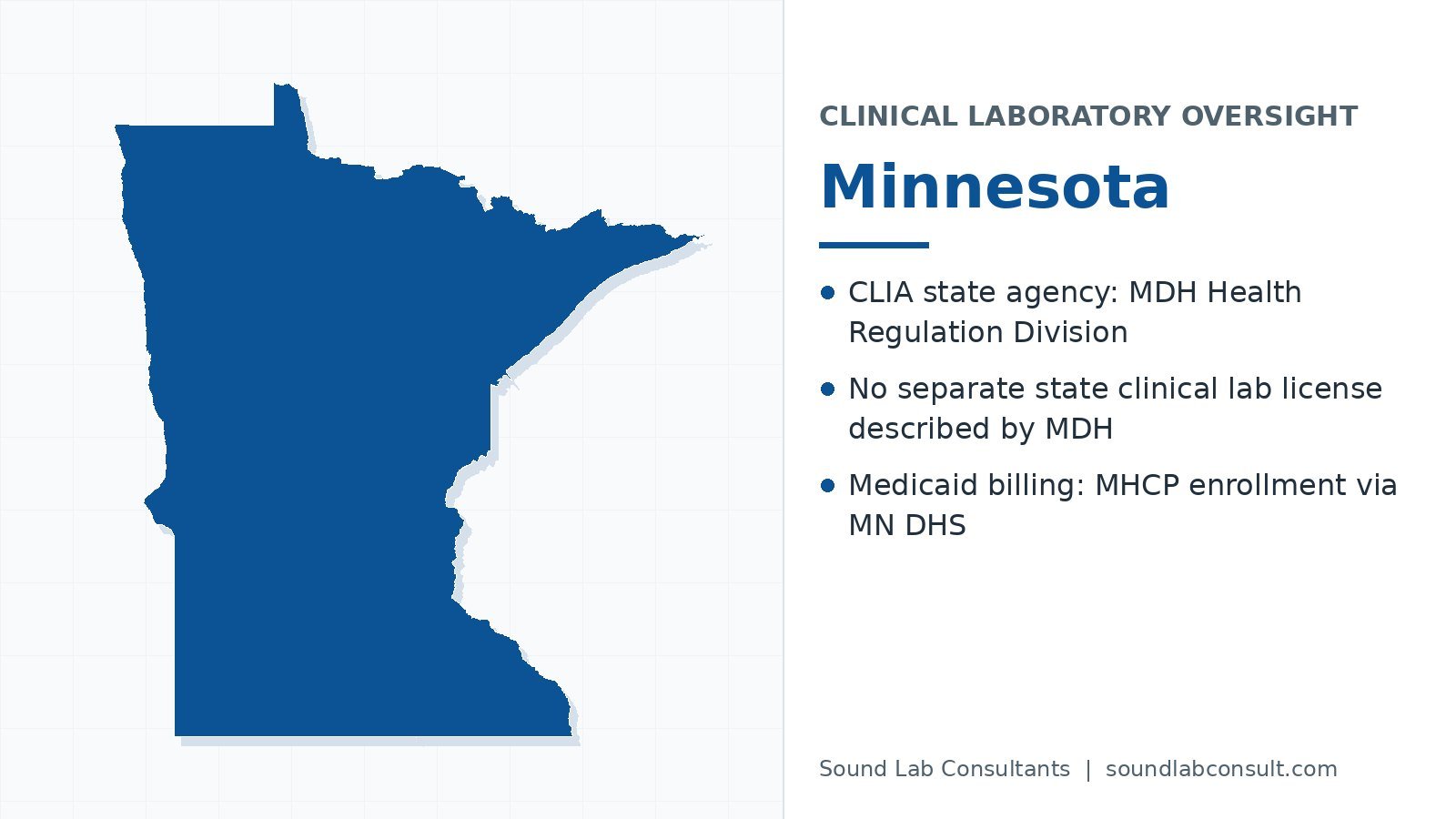
Short answer: Minnesota clinical labs are regulated through federal CLIA. The Minnesota Department of Health (MDH) Health Regulation Division runs the CLIA program as the state agency: it receives Form CMS-116, records changes and surveys labs for CMS. MDH's CLIA pages describe only the federal certificate, and we found no separate Minnesota clinical laboratory facility license. Labs that bill Medical Assistance or MinnesotaCare also enroll with Minnesota Health Care Programs (MHCP) at the Department of Human Services, and environmental labs use a different MDH program (MNELAP).
Last reviewed: November 20, 2026. Sources: CMS CLIA State Agency Contacts (revised September 2026), Minnesota Department of Health: CLIA program, Minnesota Department of Health: CLIA FAQ.
What a Minnesota lab consultant does
A Minnesota lab consultant helps clinical labs get and keep federal CLIA certification through the Minnesota Department of Health, enroll with MHCP when they bill Medical Assistance, and pass surveys and accreditation inspections. Typical work: new lab startup, Form CMS-116, director and staffing plans, method validation, proficiency testing, quality systems and survey preparation.
Minnesota has no separate state clinical lab license described by MDH, so the work centers on CLIA, MHCP billing rules and, for labs that also test water or soil, MDH environmental accreditation.
Minnesota regulator at a glance
- CLIA state agency: MDH Health Regulation Division, CLIA Program, P.O. Box 64900, St. Paul, MN 55164-0900, (651) 201-4200, health.clia@state.mn.us.
- Form CMS-116 goes to MDH; certificates and fee coupons are electronic after March 1, 2026.
- Certificate lookup: CMS QCOR CLIA Laboratory Lookup.
- Medicaid billing: MHCP enrollment with the Minnesota Department of Human Services (independent lab provider type 80).
- Environmental labs: MDH MNELAP, a separate program from CLIA.
- Full details: Minnesota clinical lab licensing and CLIA.
How to hire a lab consultant in Minnesota
- Write down your goal: new lab, certificate upgrade, new specialty, director change or survey response.
- Confirm the state path: Health Regulation Division, CLIA Program (health.clia@state.mn.us).
- Ask each consultant for Minnesota experience, a written scope and deliverables (procedures, validation reports, quality plan, competency records).
- Check independence: no consultant can promise approval or speak for CMS, the state or an accreditor.
- Send your test menu, instruments, current certificate and staff credentials so the quote is specific.
Full checklist: Hire a Minnesota lab consultant.
Starting a new clinical lab
- Define the test menu and look up each test's FDA complexity (waived, moderate, high).
- Pick the CLIA certificate path: Waiver, PPM, or Registration followed by Compliance or Accreditation.
- Secure a qualified laboratory director and, for non-waived testing, a technical consultant or technical supervisors.
- Plan space, instruments, LIS and specimen flow; write the procedure manual and quality plan.
- File Form CMS-116 with the state agency, pay the CMS fee, and confirm the certificate before patient testing.
- Verify or validate every non-waived method, enroll in proficiency testing, train staff and document competency.
- Prepare for the first state agency survey or accreditation inspection.
For the full national checklist, see the pillar guide How to start a clinical laboratory.
How to get a CLIA certificate in Minnesota
- Confirm the complexity of every test you plan to run and choose the certificate type.
- Line up a qualified laboratory director (and technical consultant or supervisors for non-waived testing). For a director change, MDH asks for the new director's qualification documents.
- Complete Form CMS-116 (Form CMS-116 (CLIA application)) and send it to the MDH CLIA Program at health.clia@state.mn.us or by mail.
- Watch your email: MDH says that after March 1, 2026 paper fee coupons and CLIA certificates are no longer available, so labs must sign up for email notifications to receive electronic fee coupons and certificates.
- Pay the CMS fee. MDH says a new facility may begin testing as soon as it has verification from MDH that CMS received payment; it does not need to wait for the printed certificate. Ask through the CLIA hotline (651-201-4120) or health.clia@state.mn.us.
- Do not test before that point. MDH says a facility that started without a certificate must stop until the fee is paid and verified.
- Renew every two years: CMS mails a bill and paying it renews the certificate.
Changes go to MDH with your CLIA number. For a change of ownership, MDH asks for a new Form CMS-116 with a cover letter giving the CLIA number and effective date (Minnesota Department of Health: CLIA FAQ).
Method validation and verification
Before reporting patient results on a non-waived test, CLIA requires the lab to check method performance (42 CFR 493.1253 (method performance specifications)):
- Unmodified FDA-cleared or approved tests: verify accuracy, precision, reportable range and that the manufacturer's reference intervals fit your patient population.
- Modified FDA tests and laboratory developed tests: establish accuracy, precision, analytical sensitivity, analytical specificity, reportable range, reference intervals and any other needed characteristics.
- Keep the plan, raw data, statistics and the director's signed approval together; surveyors ask for them.
Proficiency testing
Labs with a Certificate of Compliance or Certificate of Accreditation must enroll in a CMS-approved proficiency testing (PT) program for each regulated analyte they test (42 CFR Part 493, Subpart H (proficiency testing)).
- Test PT samples the same way as patient samples, by the people who normally run the test.
- Never send PT samples to another lab or discuss results with another lab before the reporting deadline.
- Review every PT result, investigate any failure, and document the corrective action.
- For tests without a PT program, verify accuracy at least twice a year by another method, such as split samples.
Surveys and deficiencies
- Certificate of Compliance labs are surveyed by the state agency for CMS, generally on the two-year certificate cycle.
- Certificate of Accreditation labs are inspected by their accreditor; CMS and the state agency can still do validation and complaint surveys.
- Surveyors follow CMS State Operations Manual Appendix C (survey procedures and interpretive guidelines for laboratories).
- Deficiencies are written on Form CMS-2567. The lab answers with a plan of correction that shows what was fixed, how, by whom and by when, and how it will stay fixed.
Planning a Minnesota lab or fixing a survey finding? Get a free review of your test menu, certificate path and staffing.
CLIA lab director and personnel roles
| Role | When CLIA requires it | Rule |
|---|---|---|
| Laboratory director | Every non-waived lab (moderate or high complexity) | 42 CFR 493.1405 (moderate), 493.1443 (high) |
| Technical consultant | Moderate complexity testing | 42 CFR 493.1411 and 493.1413 |
| Technical supervisor | High complexity testing, by specialty | 42 CFR 493.1449 and 493.1451 |
| Clinical consultant | Moderate and high complexity | 42 CFR 493.1417 and 493.1455 |
| General supervisor | High complexity testing | 42 CFR 493.1461 and 493.1463 |
| Testing personnel | Anyone performing non-waived tests | 42 CFR 493.1423 (moderate), 493.1489 (high) |
CMS revised the CLIA personnel rules effective December 28, 2024. High complexity directors who were qualified and serving in a CLIA-certified lab on that date, and have served continuously since, remain qualified (42 CFR 493.1443 (high complexity director)). A director may direct no more than five laboratories and must be on site at least once every 6 months, with at least 4 months between the two visits, and stay reachable for consultation (42 CFR 493.1407 for moderate complexity). Competency for testing staff is assessed twice in the first year on a test system and yearly after that.
How to look up a CLIA certificate in QCOR
CMS's Quality, Certification and Oversight Reports site (QCOR) lists every active CLIA-certified lab. CMS says labs can use it to access and reprint their CLIA certificate (CMS: Laboratory performance and QCOR certificate lookup).
- Open the CMS QCOR CLIA Laboratory Lookup page.
- Search by facility name (full or partial), CLIA identification number, lab director, state, or ZIP code (use * for missing digits, such as 553**).
- Read the result: CLIA number, facility name, the address where testing is performed, certificate type and expiration date.
- Open the certificate link to view or print the current electronic certificate.
- QCOR searches active labs only and is updated weekly.
- A lab applying for Compliance or Accreditation shows a Certificate of Registration until compliance is determined.
- Use it to confirm a reference lab's certificate type before sending specimens, and to check your own record after MDH processes a change. For questions about a Minnesota record, contact MDH.
MHCP provider enrollment for Minnesota labs
Minnesota Health Care Programs (Medical Assistance and MinnesotaCare) are administered by the Minnesota Department of Human Services, not MDH. An independent laboratory enrolls as MHCP provider type 80 (Minnesota DHS MHCP Provider Manual: Independent laboratory enrollment).
- The facility must be CLIA-certified and must pay a provider screening fee to MHCP, or show it was paid to Medicare or another state Medicaid agency.
- Enroll online through the Minnesota Provider Screening and Enrollment (MPSE) portal and upload the Provider Agreement (DHS-4138), a copy of the CLIA certificate and the fee confirmation.
- Or fax the Organization Provider Enrollment Application (DHS-4016A), DHS-4138, the Disclosure of Ownership (DHS-5259), the optional EFT form (DHS-3725), the CLIA certificate and the fee confirmation to MHCP Provider Eligibility and Compliance at 651-431-7462.
- DHS says to allow 30 days for processing.
MHCP pays only for lab services allowed under the lab's CLIA certificate. If the CLIA number changes or was not on the application, fax the new CLIA number, expiration date, provider name and NPI to MHCP. Certain waived-test codes need the QW modifier, and a CLIA-certified provider NPI must appear in the rendering, pay-to or service facility field (Minnesota DHS MHCP Provider Manual: Laboratory and pathology services).
Clinical labs vs environmental and food labs in Minnesota
CLIA covers testing of human specimens for diagnosis, prevention or treatment. Labs that test water, soil, air, food or other non-human samples do not need a CLIA certificate for that work, but they may need other accreditation.
- MDH's Environmental Laboratory Accreditation Program (MNELAP), set up in 1989, accredits environmental labs for programs such as the Safe Drinking Water Act, Clean Water Act, RCRA and the Underground Storage Tank Program (MDH Environmental Laboratory Accreditation Program (MNELAP)).
- Requirements come from Minn. Stat. 144.97 to 144.99 and Minn. Rules chapter 4740; accredited labs follow the 2016 TNI Standard (effective January 1, 2021) (MNELAP: Accreditation requirements for laboratories).
- MNELAP labs take two proficiency testing studies per calendar year for each field of testing (MNELAP: Proficiency testing requirements).
- To learn whether environmental accreditation is required, MNELAP says to ask the agency that will receive the results.
Workplace drug testing has its own rule: under Minn. Stat. 181.953 (workplace drug testing laboratories), Minnesota employers must use a laboratory certified under the federal workplace drug testing guidelines, accredited by CAP's forensic urine drug testing program, or licensed by New York for drug testing.
Sound Lab Consultants works on clinical (CLIA) laboratories. A lab that runs both clinical and environmental testing needs both tracks.
Minnesota service areas
Sound Lab Consultants supports clinical labs across Minnesota remotely and through scheduled on-site visits. It does not maintain an office in Minnesota.
- Twin Cities (Minneapolis, St. Paul and the metro): physician office labs, urgent care, specialty clinics, toxicology and molecular reference labs.
- Rochester and southeast Minnesota: specialty clinic labs and labs adding moderate or high complexity testing.
- Duluth and the Arrowhead: hospital, clinic and outreach labs with small teams.
- St. Cloud and central Minnesota: clinic labs, long-term care testing and new startups.
Minnesota lab consultant jobs and roles
People searching for Minnesota lab consultant jobs usually mean one of three things: an employed laboratory role with consulting duties, a CLIA position filled on contract, or an independent consulting firm.
| Role | What it usually involves | Typical qualification basis |
|---|---|---|
| Laboratory director (on contract or part time) | Signs the CLIA application, owns quality and must visit the lab on site at least every 6 months | 42 CFR 493.1405 or 493.1443 |
| Technical consultant | Moderate complexity oversight: verification, QC, PT and competency | 42 CFR 493.1411 |
| Technical supervisor | High complexity oversight by specialty | 42 CFR 493.1449 |
| Compliance or quality consultant | Procedures, mock inspections, corrective action, survey response | Experience; no CLIA position |
| Startup consultant | Certificate path, Form CMS-116, layout, instruments, validation | Experience; no CLIA position |
Minnesota does not license lab personnel, so CLIA Subpart M and employer requirements set the bar. Employed roles cluster in the Twin Cities and Rochester health systems and reference labs; contract director and technical consultant roles are common for clinics in greater Minnesota.
If you are hiring rather than job hunting, see the questions and scope list on the hire page.
How Sound Lab Consultants helps
- New lab startup: certificate path, Form CMS-116, director and staffing plan, procedure manual and quality plan.
- Method verification and validation plans and reports under 42 CFR 493.1253.
- Proficiency testing enrollment, review and corrective action.
- Mock inspections against CMS Appendix C, CAP, COLA or Joint Commission standards, and plans of correction after a CMS-2567.
- Director and technical consultant qualification checks against Subpart M, plus state personnel license checks.
- Sound Lab Consultants is an independent firm headquartered at 25 Arizona Pl, Chandler, AZ 85225. It serves labs remotely and through scheduled on-site visits, and is not affiliated with CMS, any state agency or any accreditor.
Frequently asked questions
What does a Minnesota lab consultant do?
Helps clinical labs with CLIA certification through the state agency, lab startup, director and staffing plans, method validation, proficiency testing, quality systems and survey or accreditation preparation.
Does Minnesota require a state clinical laboratory license?
MDH's CLIA program pages describe only the federal CLIA certificate, and we found no separate Minnesota clinical laboratory facility license. Minnesota labs need the CLIA certificate that matches their most complex test.
Who is the CLIA state agency in Minnesota?
The Minnesota Department of Health, Health Regulation Division, CLIA Program: P.O. Box 64900, St. Paul, MN 55164-0900, phone (651) 201-4200, email health.clia@state.mn.us.
Where do I send Form CMS-116 in Minnesota?
To the MDH CLIA Program at health.clia@state.mn.us or by mail to the address above. CMS then bills the fee; MDH says a new lab may start testing once MDH verifies CMS received payment.
How do I look up a Minnesota lab's CLIA certificate?
Use CMS QCOR's CLIA Laboratory Lookup (qcor.cms.gov). Search by name, CLIA number, director, state or ZIP; results show certificate type and expiration, and you can open the electronic certificate.
Does Sound Lab Consultants have an office in Minnesota?
No. Sound Lab Consultants is headquartered at 25 Arizona Pl, Chandler, AZ 85225 and serves Minnesota labs remotely and through scheduled on-site visits.
Sources
- CMS CLIA State Agency Contacts (revised September 2026)
- Minnesota Department of Health: CLIA program
- Minnesota Department of Health: CLIA FAQ
- Form CMS-116 (CLIA application)
- CMS QCOR CLIA Laboratory Lookup
- CMS: Laboratory performance and QCOR certificate lookup
- Minnesota DHS MHCP Provider Manual: Independent laboratory enrollment
- Minnesota DHS MHCP Provider Manual: Laboratory and pathology services
- MDH Environmental Laboratory Accreditation Program (MNELAP)
- MNELAP: Accreditation requirements for laboratories
- MNELAP: Proficiency testing requirements
- Minn. Stat. 181.953 (workplace drug testing laboratories)
- NYSED chart of states that license clinical laboratory personnel
- 42 CFR Part 493 (CLIA regulations)
- 42 CFR Part 493, Subpart M (personnel)
- 42 CFR 493.1443 (high complexity director)
- 42 CFR 493.1253 (method performance specifications)
- 42 CFR Part 493, Subpart H (proficiency testing)
Related: Minnesota clinical lab licensing and CLIA | Hire a Minnesota lab consultant | How to start a clinical laboratory | All-state CLIA and license guide
Sound Lab Consultants, 25 Arizona Pl, Chandler, AZ 85225, is an independent consulting firm. It is not affiliated with CMS, any state agency or any accreditor, and it cannot grant certificates, licenses or accreditation. This page is educational and not legal advice.
Talk through your Minnesota lab.